


Villa Leuchtenberg
Brief Description
Detailed Description
For Théodelinde de Beauharnais (1814–1857), it was not only the magnificent setting and the mild climate that made the shores of Lake Constance in Lindau an ideal location for a summer residence. Admittedly, she, too, felt reminded of Italy, like so many wealthy and noble people who had villas and summer residences built here beginning in the mid-19th century. But her primary concern was her health, which had been severely compromised since childhood.
Thus, the young Théodelinde—whose father, Eugène de Beauharnais, was a stepson of Napoleon Bonaparte (1769–1821)—was drawn south primarily because the climate seemed to be beneficial for her lung condition. It is not known exactly what the princess suffered from; however, tuberculosis is suspected. Théodelinde actually lived in Stuttgart with her husband, Duke Wilhelm of Urach. Thus, the Bavarian shore of Lake Constance was literally a close alternative to distant Italy.
A Summer Residence for a Short Time
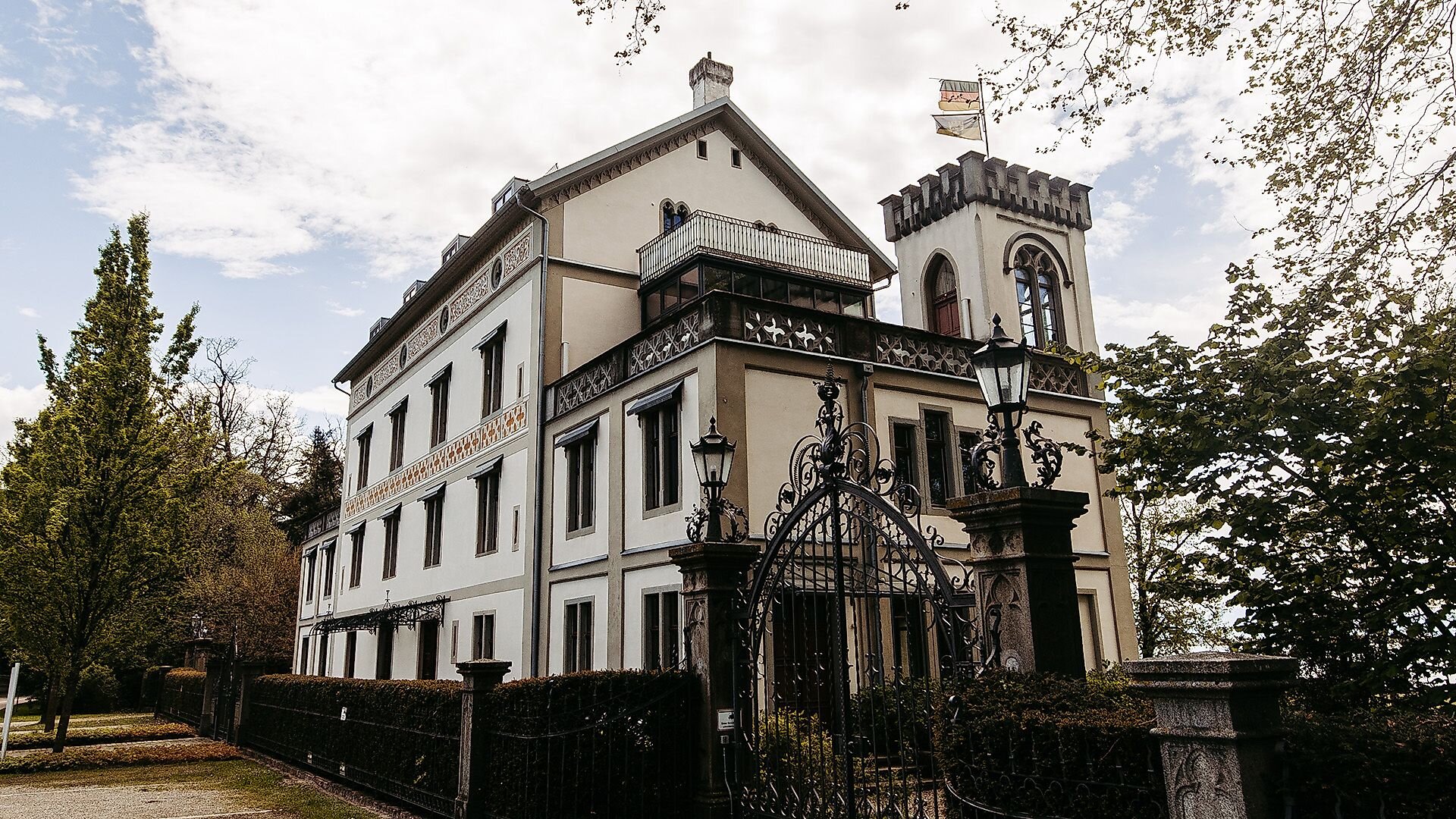
The princess finally found what she was looking for in 1853, when she acquired the so-called Haug Estate in Lindau. Based on Théodelinde’s vision, the Munich architect Anton Harrer converted the existing customs house into a summer villa. The outbuildings were demolished to make way for a spacious park and a private harbor. Harrer was not a random choice; he had already made a name for himself in Bavaria with several large-scale buildings in the spirit of Historicism.
Unfortunately, her summer residence no longer had a positive effect on the princess’s fragile health: the renovation work dragged on until 1855, and Théodelinde de Beauharnais passed away just two years later. But the fascinating history of Villa Leuchtenberg does not end there. In 1886, Théodelinde’s daughter sold the residence to the Vorarlberg textile manufacturer Samuel Wilhelm Schindler.
Technical Pioneering Achievements Behind a Historic Facade
Schindler gifted the estate to his son Cosmus, who immediately set to work and had the villa and grounds adapted to his vision. He had the outbuildings—which had been demolished 30 years earlier—rebuilt and equipped the villa with a modern central heating system. His brother, Wilhelm Schindler, was regarded in Vorarlberg as an “electrical pioneer,” and for good reason. He even installed an electrical supply in his younger brother’s villa. The electricity came via a transmission line from the Schindler factory across the border—making Villa Leuchtenberg the first building in all of southern Germany to have electricity!
What Stands Empty for a Long Time Can Still Turn Out Well
Schindler’s descendants, however, now use the villa only occasionally as a summer vacation home. As is so often the case, maintaining such a sophisticated structure proved to be a major challenge for the family over time. Perhaps the vacancy and neglect played a role when the city of Lindau, in 1973, had a lakeside path built in front of the villa without further ado—right through the middle of the private property.
For 30 years, Villa Leuchtenberg—one of the most beautiful estates on the Lindau shore of Lake Constance—stood largely vacant. As if the neglect hadn’t already done enough damage, two fires in 1991 and 1995 caused further severe damage. Nevertheless, it took a good ten years before a tentative happy ending emerged: After a change in ownership, Villa Leuchtenberg underwent extensive renovation from 2005 to 2008. Today, it houses both residential and office spaces.
Location
- Address
-
Villa Leuchtenberg
Eichwaldstraße 82
88131 Lindau