


DE
Überlingen Garden Culture Trail
Description
The Überlingen Garden Culture Trail connects the city’s most beautiful parks and gardens along a route of about four kilometers. Stunning views of the lake and the historic old town alternate with green oases of tranquility. The centerpiece of this fully signposted loop trail is the Stadtgarten, a designated historic landmark.
Summary
The Überlingen Garden Culture Trail connects the city’s most beautiful parks and gardens along a route of about four kilometers. Stunning views of the lake and the historic old town alternate with green oases of tranquility. The centerpiece of this fully signposted loop trail is the Stadtgarten, a designated historic landmark.
Description
The walk begins at the Badgarten. From here, the route follows the waterfront promenade, crosses the small bridge at the Gondele Harbor, and leads into the villa gardens, which served as an exhibition area during the 2021 State Garden Show. The newly built greenhouse with its large cactus collection is worth a visit.
The route then continues along Bahnhofstraße to the Hotel Stadtgarten, where the path branches off to the right in front of the so-called “Devil’s Stairs” into the Lower City Garden.
On the way through the Lower City Garden, you’ll pass the Rose Garden. A detour leads to the Upper City Garden with its observation pavilion. In the Lower City Garden, the trail continues through Fuchsienweg/Gallergraben.
Passing the Aufkircher Tor, the path leads through the Scheerengraben and the Wagsautergraben—along the Kesselbach—to the cemetery. From there, the path runs past the train station to the Rosenobel/Nellenbachgraben, as well as to the St. Franziskus Garden, and on to the Municipal Museum with its panoramic garden.
Via the Menzinger Gardens—which also served as an exhibition area during the State Garden Show—you return to the flower-filled riverside promenade and the Landungsplatz.
Tip
With its many playgrounds, the "Hexenhäusle" (witch's cottage), and the deer enclosure in the Stadtgarten, this tour is also ideal for families.
Directions
We begin our walk along the Überlingen Garden Culture Trail at the entrance to the Badgarten. The garden once served as the garden of the former Capuchin monastery, whose church still stands. It became the spa park in 1868, after the Bad-Hotel opened and the city wall along the lake was demolished. A redesign following the establishment of the spa park has defined its current appearance since 1953. The old tree population—part of which is protected as a natural monument—is impressive, featuring a plane tree, a mighty beech, and the giant sequoia that stands alongside them. In the spring, the lawns transform into carpets of tulips, daffodils, and bluebells. In the flower beds, plants in bloom delight the eye as the seasons change. Toward the promenade, perennials bloom among grasses, hibiscus, and roses. From the benches by the lake, we can watch the activity on the water and along the promenade.
After leaving the Badgarten via the steps leading down toward Lake Constance, we continue walking along the lakeside promenade to the right. Shortly after passing the small bridge at the gondola harbor, we arrive at the Villa Gardens (formerly the Kurpark am See).
On a stroll through the Villengärten’s arboretum, you can spot an ash tree, a tulip tree, a sequoia, and a wingnut tree among the trees that are more than 60 years old. The old villa and the picturesque bathing house bear witness to Überlingen’s 19th-century bathing culture. From spring through fall, the Kneipp pool invites visitors to wade in the water. As part of the State Garden Show, which Überlingen hosted in 2021, the plant house was built, sustainably enhancing the high-quality park grounds. Starting in early summer 2022, visitors will be able to admire the city’s extensive cactus collection here, featuring specimens that are in some cases over 100 years old and up to seven meters tall. A new playground with tree trunks for climbing, swinging, and sliding has also been built.
We cross Bahnhofstraße and turn right in front of the Hotel Stadtgarten. Straight ahead, we see the steep “Teufelstreppe” (Devil’s Stairs). Its name comes from the innkeeper Anton Teufel, whose inn once stood here. Incidentally, the current staircase was inaugurated in 1999 by Erwin Teufel, then Minister President of Baden-Württemberg. In front of the “Teufelstreppe,” we turn into the Stadtgarten.
Thanks to its biodiversity and the harmonious blend of wild and landscaped nature, the Überlingen Stadtgarten ranks among the most significant botanical gardens in the Lake Constance Four-Country Region. Its climatically favorable location at the foot of the molasse cliffs allows Mediterranean and exotic plants to thrive in a relatively small area. The garden owes its creation to the city’s desire to offer an attractive park to the growing number of spa and bathing guests who visited throughout the 19th century. In 1875, the castle gardener of Heiligenberg was commissioned to create a garden on the vineyard and vegetable plots located west of the city. The first plants came from Mainau Island, where a grand ducal park had existed since 1855.
The design of the western part of the city garden dates back to the 1950s. In the arboretum, we find a number of unique specimens, such as the Atlas cedar, araucaria, dawn redwood, Judas tree, and handkerchief tree. Just before the rose garden, on the left, we can admire a beautifully grown ginkgo tree—a gift from the Saxon town of Bad Schandau to mark the tenth anniversary of its sister city partnership with Überlingen.
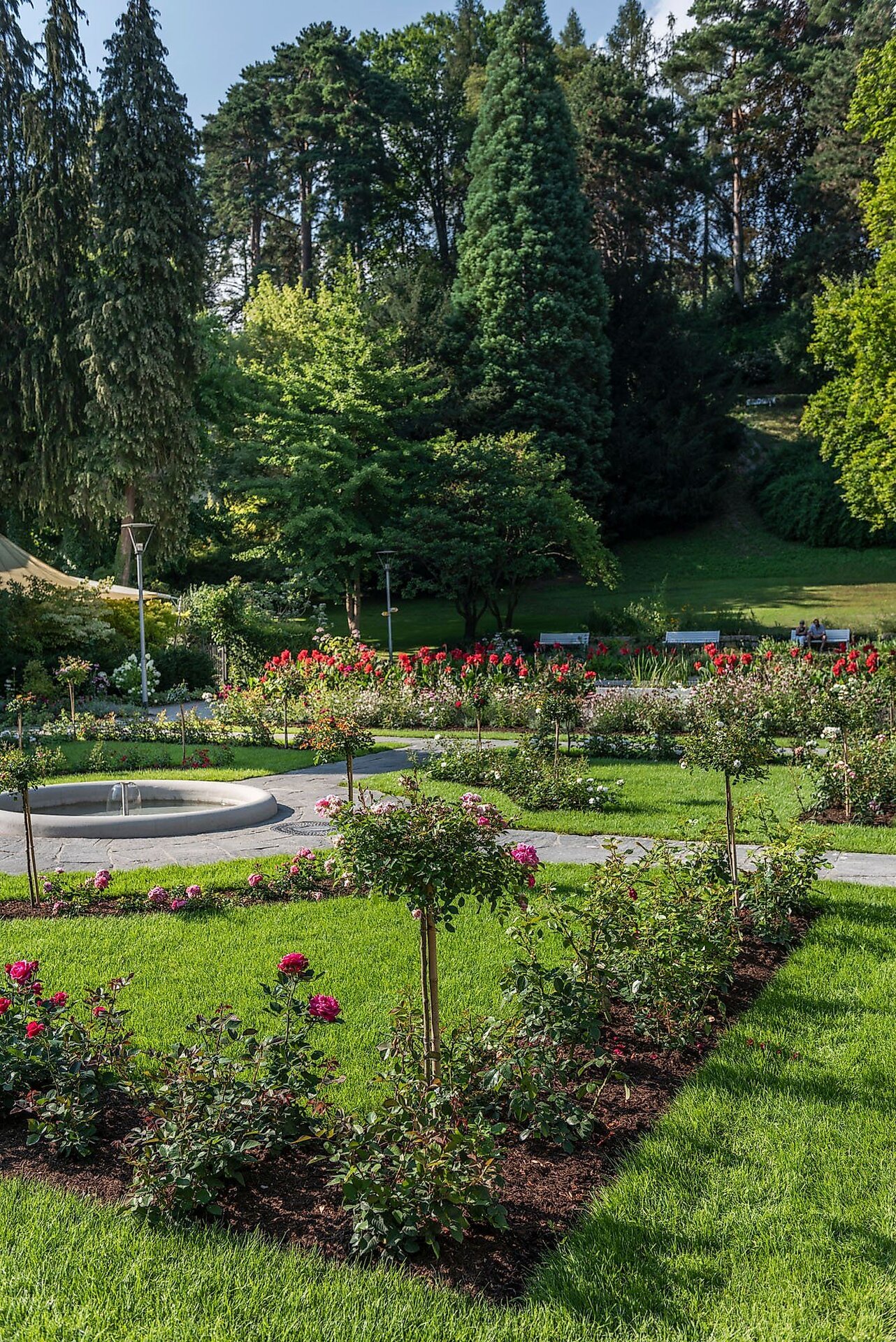
The rose garden is located in the newer part of the city park. It was laid out in 1939 in the French style, featuring geometric beds and paths as well as two ponds with flowing water. During the blooming season, hybrid tea roses such as “Gloria Dei,” “Duftwolke,” and “Sutter’s Gold” enchant the senses with their fragrance. Cozy nooks around the rose beds invite you to linger and enjoy the moment. In addition to the roses, the garden also features rare flowering shrubs such as spirea and Chinese lilac, as well as numerous climbing plants. In the spring, when it’s teeming with frogs and newts, the rectangular pond is a special attraction for young and old alike. At that time, countless daffodils also bloom on the grassy slope above the rose garden.
The path to the eastern part of the city garden and the rotunda surrounding the picturesque fountain are lined with benches that invite visitors to take a break. As the fountain water splashes, you can admire the newly designed, winter-hardy cactus garden, bright-green magnolias, and banana trees set against the backdrop of spreading beech trees. A few steps further toward the city wall, we’re surprised by imposing giant trees and botanical rarities such as the giant arborvitae, river cedar, Japanese umbrella pine, false cypress, swamp cypress, and the true fig tree.
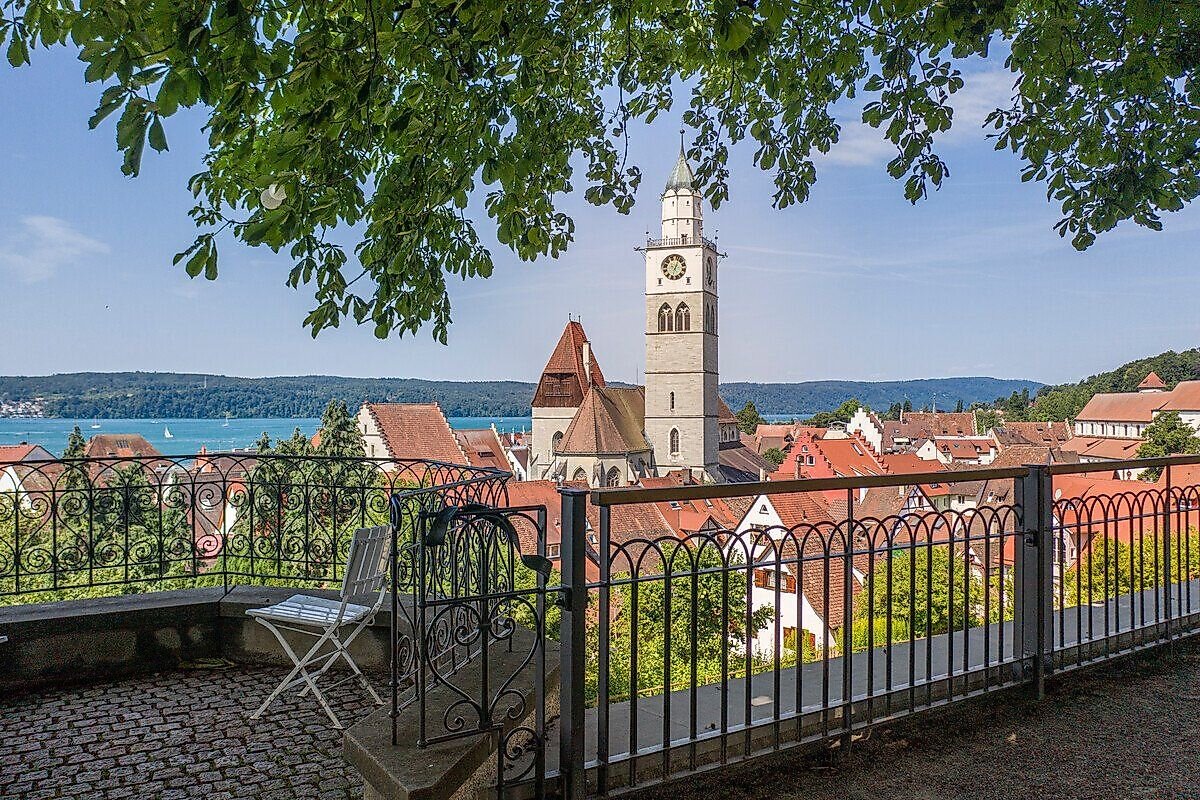
If you’d like, you can take a detour to the Upper City Garden to enjoy the view of the cast-iron pavilion, which is more than 120 years old. Our gaze wanders straight across Lake Überlingen to the Bodanrück and to the left over Überlingen’s old town—with the striking tower of St. Nicholas Cathedral—toward Lake Obersee and the chain of Alpine peaks. When we look down, we can make out the layout of the Stadtgarten and spot the fountain with the newly redesigned cactus garden. To the left, the city wall and the Gallerturm rise majestically. In the immediate vicinity of the pavilion, the so-called “Hexenhäusle”—a Norwegian-style hermitage dating from 1905—and the deer enclosure further into the forest are sure to delight visitors of all ages.
The actual Garden Culture Trail, however, continues through the lower part of the City Garden, where, between the parking garage and the towering Gallerturm (1502/03), the Fuchsia Trail winds its way at the foot of the imposing city wall. The path is lined with various species of fuchsias in the form of shrubs and small trees. We follow the Fuchsia Path to the left into the Gallergraben. Construction of this section of the city fortifications began in the early 16th century. Like most of Überlingen’s city moats, the Gallergraben is man-made. In winter, water seeping out at various points and collecting in a small stream transforms the vertical cliffs—which rise up to 20 meters high—into bizarre ice walls.
For several years now, a pair of eagle owls has been nesting in Überlingen’s Gallergraben. When the young owls fledge in early summer, this section of the Gallergraben must be temporarily closed to prevent endangering the young birds during their first attempts at flight. In the event of a closure, we follow the path out of the Stadtgarten toward Bahnhofstraße. At the street, we turn left toward the parking garage. In front of the parking garage, the Sebastian-Kneipp-Steige trail leads to the Gallerturm. There, a panoramic view high above the rooftops of the Old Town highlights the Old Town’s landmarks and the imposing mountain peaks of the Alps. The trail continues uphill to the Uhlandhöhe. A steel footbridge, up to 12 meters high, offers breathtaking views into the Blatterngraben, across which you then reach the regular route of the Garden Culture Trail again via a staircase.
At the Aufkircher Tor, the northern city gate, the Gallergraben transitions into the Scheerengraben. The picturesque, medieval-style turret at the beginning of the moat was built in 1901 to provide ventilation for the railroad tunnel, which runs in a wide arc beneath the city. The gate and moat were constructed in the 14th and 15th centuries, when the “village”—inhabited by winegrowers and farmers—was incorporated into the city’s fortifications. This section of the moat, which remains close to nature, has a wooded atmosphere. In the spring, the scent of wild garlic wafts from beneath the trees. A spring rises on the hillside; its water flows through the bottom of the moat and feeds the Kesselbach stream.
High above the bend between the Scheerengraben and the adjoining Wagsautergraben, the Wagsauter Tower rises at the highest point of Überlingen’s Old Town. Today, we see a reconstruction of the late-medieval structure, built in 1958–60. The Kesselbach accompanies us on our way through the wooded Wagsautergraben, eventually flowing into the Nellenbach. We’ll encounter the Nellenbach later when we walk through the inner ditch around the city center.
Immediately after the underpass, we climb the stairs on the right and cross Friedhofstraße at the crosswalk. We then turn left onto Feigentalweg. Here we enter the cemetery at the boundary between the older section, which extends down the slope, and the newer section. Since 1530, the people of Überlingen have been buried not at the cathedral but in this cemetery located outside the city walls. The city acquired the land from the “little convent on the meadow.” The main path, laid out lengthwise, runs through the graveyard as its central axis. The cemetery is characterized by old yew trees—some of which are pruned into strict shapes—and large linden trees planted around 1940. Before we leave the cemetery through the main entrance toward the train station, we pass the “Gottesackerkapelle.” After the old chapel was severely damaged during the Thirty Years’ War, Johann Heinrich von Pflummern, a councilman from Überlingen, had the current small Baroque chapel built in 1662–64.
After crossing Wiestorstraße at the traffic light, we leave the train station grounds behind us and descend the stairs to the left of the station kiosk into the Nellenbachgraben. At the so-called Rosenobel—the massive round bastion—we now descend into the oldest section of the moat that formed part of the city’s fortifications. After Überlingen was granted market rights around 1180 and became a town in the early 13th century, it surrounded the town center with walls, moats, towers, and gates. After just a few meters, we can already sense the characteristic atmosphere of this moat system: silence, greenery, and freshness. The path runs parallel to the Nellenbach stream, alongside moss-covered sandstone walls and the historic city wall.
If you’d like to take a shortcut, you can follow the road from the Aufkircher Gate into the village of Überlingen. At the Bürgerbräu restaurant, we turn left and make our way through the maze of alleys to the Susohaus, whose tranquil garden invites you to linger and reflect. From there, the path leads us down to Wiestorstraße and across the Nellenbachgraben back to the signposted main route of the Garden Culture Trail.
At the fork in the path, we keep to the left and leave the Stadtgraben at the Weinhaus Renker. We cross Olberplatz, with its beautifully designed flower bed created by the Überlingen Beautification Association (Verschönerungsverein Überlingen e.V.), and take a look at the garden of the St. Franziskus Retirement Home, which we reach via Spitalgasse. With a view of the cathedral, we can relax here in the heart of the bustling Old Town on a bench surrounded by greenery. Two old linden trees provide shade. A ring of globe maples surrounding the choir of the Franciscan Church complements the tree population. Geometrically arranged boxwood hedges and perennial beds echo the design of old monastery gardens. In May, the lawns are dotted with daisies; in June, the linden trees fill the air with their fragrance.
After leaving the garden by the same path, a stroll along Krummebergstraße takes us to the next stops.
On the left are the Rosenobel Gardens, which were renovated as part of the State Garden Show and are now open to the public. The hidden gardens right next to the city wall have been transformed into an attractive gem. A newly laid path winds its way up to the plateau of the Rosenobel rampart. Even the embrasures and arrow slits have been restored for visitors to experience. The 18-meter-high Rosenobel Tower remains open to the public and offers new views of the city and the surrounding area.
A few steps further along Krummebergstraße, we enter the Überlingen Municipal Museum through the museum entrance and reach its panoramic garden, which is situated on a partially man-made plateau high above the city. Since 1913, it has been housed in the Reichlin-von-Meldegg House, a patrician palace dating from the transition from the Late Gothic to the Renaissance period (1462). Visitors can explore the garden free of charge during museum hours. The garden’s charm lies in the interplay of nature, art, and culture. Noteworthy are the chestnut trees, which spread their mighty canopies over the lawns. On our walk, we encounter, among other things, sculptures from the 16th to the 19th centuries and a massive wine press. The Jewish tombstones, which are among the oldest in Baden-Württemberg, deserve special attention. From the garden’s balustrade, we enjoy a view of the city and the lake that is second to none.
We leave the museum garden to the right and cross Gradebergstraße, which leads steeply down to the city center.
We turn the corner of the building and enter the Menzinger Gardens, a special place in a fantastic downtown location. The Menzinger Gardens were also part of the green corridor network in the State Garden Show’s master plan. The view of Lake Constance across the backdrop of the historic old town is impressive. With their small allotment garden plots framed by yew hedges—which are once again being used as such following the State Garden Show—viewing terraces, and seating areas, especially in the upper part of the grounds, the Menzinger Gardens have become a place to linger, play, and enjoy oneself. The playground is particularly charming thanks to its tower, whose design is inspired by the neighboring St. Nikolaus Cathedral.
Above the Menzinger Gardens, we follow Sandbergweg—lined with walls and greenery—which leads from the St. Johann Tower to Mantelhafen, toward the waterfront promenade. The area that is now a colony of urban allotment gardens in the heart of the Old Town was already used to supply the population as far back as the Middle Ages.
The final section of the Garden Culture Trail takes us past Mantelhafen and along the promenade back to our starting point. Beyond the historic Mantelhafen—which, as the “Höllgraben,” was once part of the city’s fortifications—mighty deciduous trees tower over the former Mantelschanze. The lakeside promenade between Mantelhafen and Badgarten owes its unique Mediterranean character to seasonal plantings and palm trees in spacious flower beds. The large plane tree on the lake side of the landing stage is particularly impressive. It was planted as part of the square’s redesign in the 1970s and complemented by additional deciduous trees that define the square’s space. Since 2000, the fountain “The Horseman of Lake Constance,” created by Peter Lenk, has added an artistic touch. A little further on, near the docks of private boat operators, stands a group of trumpet trees.
Destination
Waterfront Promenade, 88662 Überlingen
Return trip from the end point to the starting point
Follow the waterfront promenade to return to the starting point (Badgarten).
Equipment
Sturdy footwear is recommended.
Starting Point
Badgarten, 88662 Überlingen
Walk-in months
- April
- May
- June
- July
- August
- September
- October
Requirements
- Condition 2 detail.requirements.value
- Experience 4 detail.requirements.value
- Landscape 5 detail.requirements.value
Details
Season
- Spring
- Summer
- Fall
Location

Publisher / Copyright: Tourist-Information Überlingen – CC BY-SA 4.0 Tourist-Information Überlingen