


Sternschanze
Brief Description
Detailed Description
Around the year 1500, work began in Lindau to construct permanent defensive fortifications. Their value became apparent many years later during the Thirty Years’ War (1618–1648), when the Swedes arrived. Fortunately, their attack was the only formal siege Lindau ever had to endure. Nor was it successful for the attackers. The Swedish troops were repelled by the resistance of the Imperial forces and the citizens of Lindau.
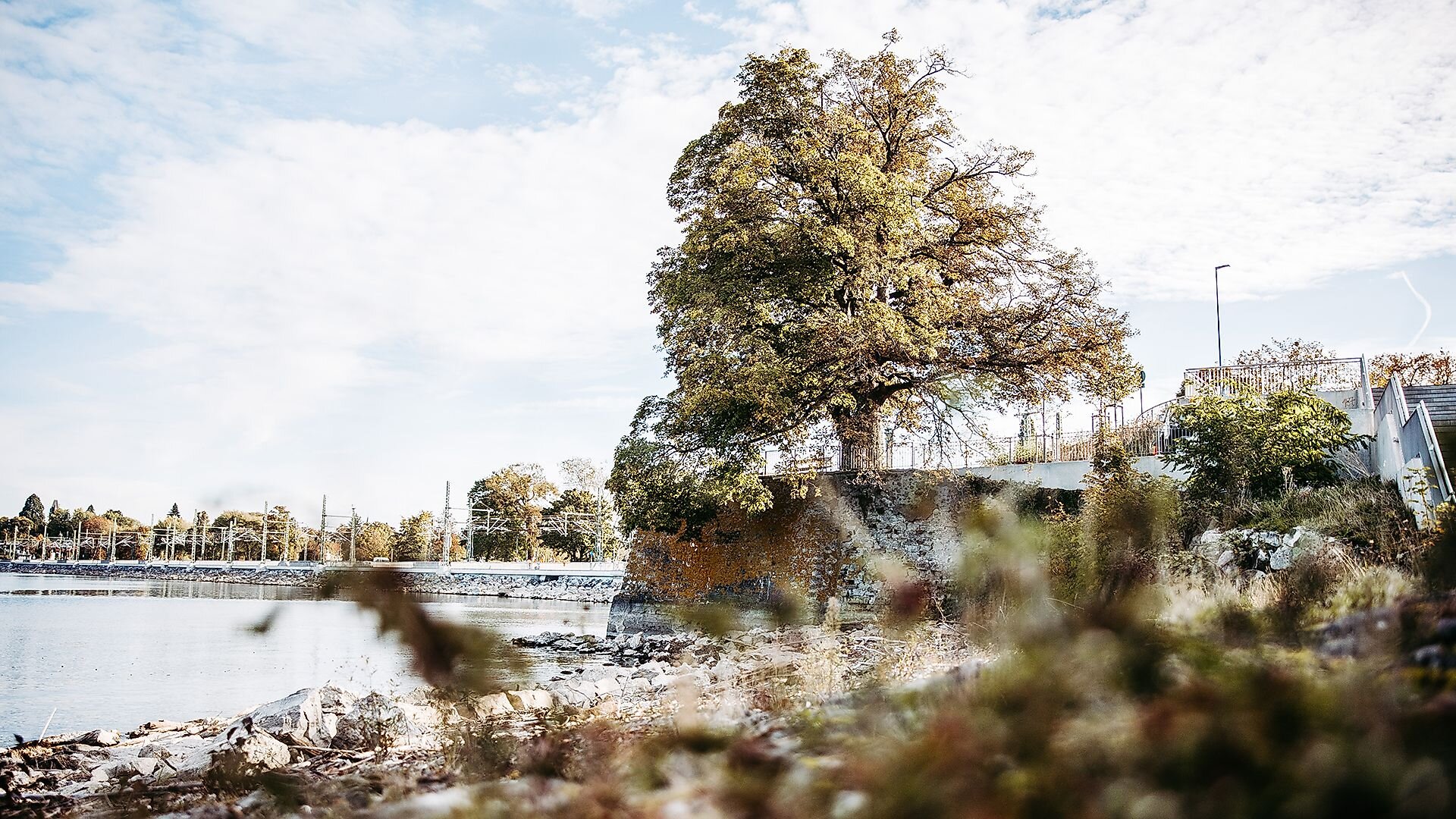
Today, not much remains of these defensive structures. The Sternenschanze is the last one that can still be seen along the Lindau Island Trail. In peacetime, however, it has a completely different significance: thanks to the small viewing platform, it offers a magnificent view of the lake—and a prime spot for spectacular sunsets in the evening hours.
The Legend of the Witch Who Fled to Lindau
For locals and visitors alike with a passion for history and the myths and legends that surround historical events, the Schanze has much more to offer—namely, a view of the Hexenstein. The Hexenstein is a block of gneiss left behind here near Lindau Island by the last Ice Age. Scientists call this kind of formation “glacial debris.” But “Hexenstein” certainly sounds more impressive. It’s only visible at low tide. Very rarely does it rise up to a meter above the water.
There were supposedly even two Hexensteine in the past. According to legend, they are so named because a witch had to flee from Switzerland and reached the shore by leaping over the stones in three bounds. The details of the legend are rather convoluted: It is said that on the Swiss shore, the itinerant monk and missionary Gallus—one of the “first to spread Christianity on Lake Constance”—was casting his fishing nets at night when he was harassed by demons “descending from a neighboring mountain.” Together with his fellow believers, Gallus confronted the evil forces fearlessly and with devout prayer, which put the demons to flight.
Among them was said to be that very witch, as the story goes, who, faced with the overwhelming strength of the fellow believers, fled across the lake toward Lindau—landing with her first step on the smaller Hexenstein, with her second on the stone that still lies there today, and finally reaching land with her third step. The *Sagenbuch der Bayerischen Lande* (Book of Legends of the Bavarian Lands) from 1853 states: “On both witch stones, the imprint of a human foot—with the toe pointing toward the Swabian side—is said to have been very clearly visible in the past.”
Or was it Saint Aurelia after all?
What became of the witch afterward is unknown. Nor is it known why the second witch stone has disappeared today. However, another legend links the stone to Saint Aurelia of Regensburg. The recluse is said to have fled from Fußach to Lindau in the 11th century due to the persecution of Christians, leaving the imprint in the rock in the process. After all, Aurelia has demonstrably left other traces behind: Although the Aurelia Chapel in Lindau dates back to early Christian times, it did bear the saint’s name for a long time.
Whether one chooses to see the imprint in the rock—carved by glacial ice—as that of a witch or a saint, the seagulls that love to frolic here whenever the lake exposes the rock likely couldn’t care less about human myths and legends.
Location
- Address
-
Sternschanze
Bad Schachen
88131 Lindau