


Scout House
Description
NATURE
You are now also in the heart of the Schlosswald Nature Reserve. The goal of this conservation effort is to preserve the natural forest communities of the Schlosswald in all their biodiversity. In particular, the mixed oak-hornbeam forest, the linden stands, the thermally influenced mixed hardwood forest, and the stands of rare native tree species—which are characteristic features of the Schlosswald—must be preserved. You’ll also find rare plants, such as the European spindle tree, orchids, and the hart’s-tongue fern.
When we walk through the Schlosswald in the morning, you can also hear birds chirping. Over 60 different bird species live in the Schlosswald. All of these unique features were already the reason, as early as 1963, for efforts to designate the Schlosswald as a nature reserve
FLINT
The ordinance establishing the Schlosswald Nature Reserve has a special significance in connection with youth culture and youth policy in Vorarlberg around 1970.
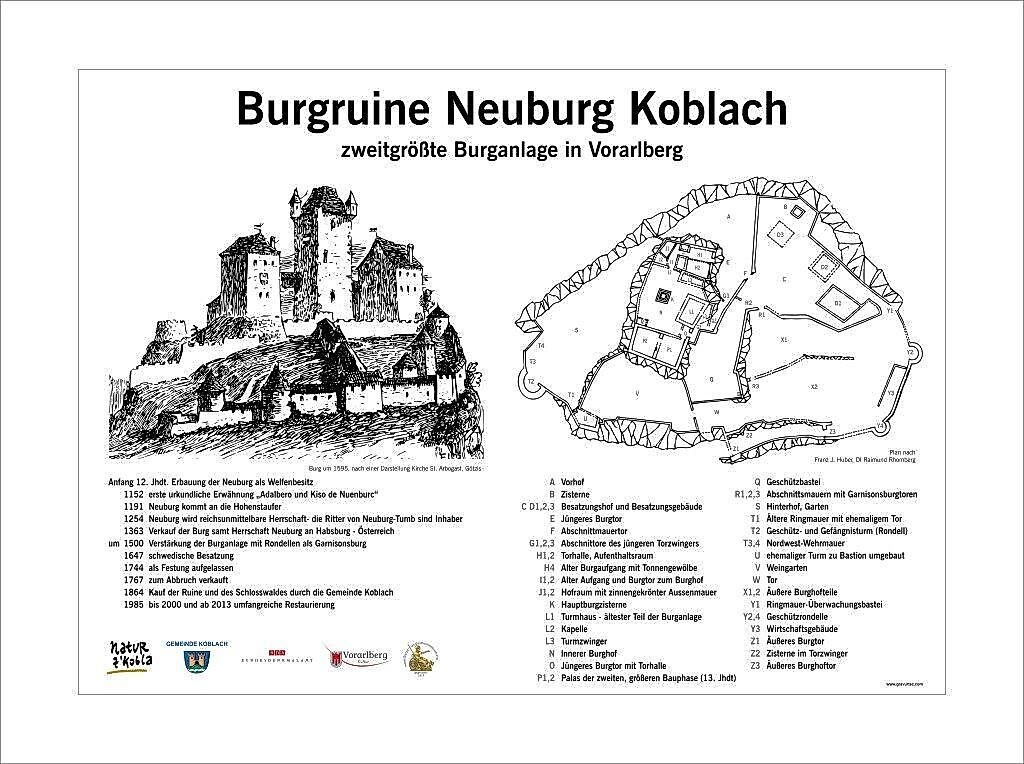
A group of young people from Vorarlberg—including Reinhold Bilgeri, Michael Köhlmaier, and Heli Burtscher—organized a festival called “Flint 1” in 1970 at the Neuburg near the Scout House, modeled after Woodstock, featuring a mix of music and texts, particularly poetry.
Encouraged by this success, the organizers wanted to expand the event in 1971 with even more bands, young poets, and folk singers. However, during the preparations, it was made clear to them that this festival could not take place. On July 5, 1971, the Schlosswald was designated a nature reserve by decree. In protest, the young people staged a “Flint funeral” on the freshly graveled right-of-way of the A14 highway, which was under construction at the time. Since authorities also sought to prevent this action, it was registered as an official demonstration. Let’s hear from an eyewitness who was there, Dr. Günter Hagen: from the book *50 Years of Rock* or a script by Günter Hagen.
Location
- Address
-
Scout House
Schloßwald 2
6842 Koblach, Austria