


Pile-Dwelling Route Information Stop: Constance Bay
Description
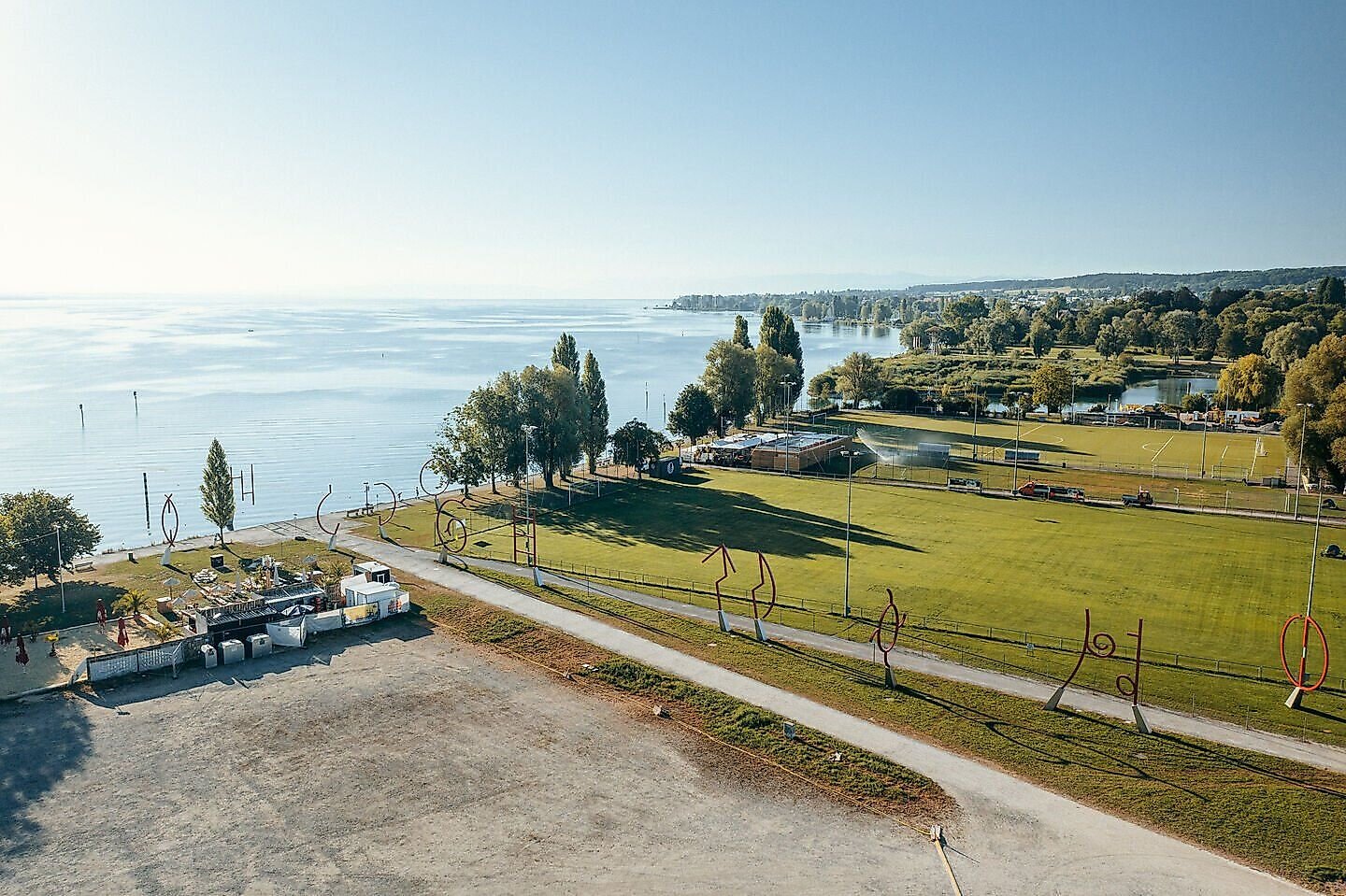
The “Überlinger See” Lake Dwelling Route connects five World Heritage sites and all other documented archaeological sites from the lake dwelling period into a single experience. The Constance Bucht information stop provides all relevant information about the lake dwelling period on site via a QR code.
Summary
The “Überlinger See” Lake Dwelling Route connects five World Heritage sites and all other documented archaeological sites from the lake dwelling period into a single experience. The Constance Bucht information stop provides all relevant information about the lake dwelling period on site via a QR code.
Description
UNESCO Lake Dwelling World Heritage Site in Constance-Hinterhausen
Dating: 3911–3910 BCE, 3891 BCE, 3877 BCE
The UNESCO World Heritage Site Constance-Hinterhausen is part of a group of settlements that controlled the crossing of the Rhine from Lake Constance into the Seerhein and the Untersee. Aerial photographs reveal numerous pile structures and house foundations. The site’s extent, as visible from the air, and the artifacts found on-site point to a long history of settlement. Of particular significance are individual finds that indicate contact with inhabitants of Upper Swabia. Research divers have discovered the oldest house ever found on Constance soil at the site. It was measured at three meters wide and eight meters long. Analyses revealed that it was built in 3910 B.C. This makes it one of the oldest Stone Age buildings on Lake Constance.
Constance Archaeological Site: Dominican Island
Estimated date: 1300–800 BC
The site was discovered in 1890 at the location of the so-called “Schwanenteich” (Swan Pond). Older documents mention stakes, stone axes, and crude clay vessels as finds from the pile-dwelling period. The Rosgartenmuseum in Constance houses several shards from the site. The structure itself has not yet been located on the grounds.
Constance Frauenpfahl Archaeological Site
Date: 1023 BCE, 975 BCE, 959–954 BCE, 934–927 BCE
The site is located in the Constance Trichter on a large shoal at the so-called Frauenpfahl. It was discovered in 1882, but at that time it was difficult to reach due to its deep location in the water. In more recent times, the site has been studied more thoroughly. The arrangement of the wooden posts revealed that the stilt houses were built parallel to the shore. The artifacts found allowed researchers to draw conclusions about settlements during various time periods. The site is evidently connected to the nearby Constance-Rauenegg and Constance-Dominikanerinsel sites, which were inhabited during the same period.
Constance Hafenstraße Site
Estimated date: 3150 BCE, 2499–2400 BCE
The site was originally located on the shore of Lake Constance. Today, the site is situated several hundred meters from the lake at an unusually high elevation of 395 m above sea level. The site was discovered during construction work for a shopping center. Parts of a pile field and scattered artifacts were uncovered, including, for example, stone axe blades made of glacial rock, which were determined to have originated from the Piz Platta massif in Graubünden. The arrangement of the posts was documented and reveals regular patterns that partially overlap, suggesting multiple periods of occupation at different times. Due to the wide strip of land occupied by the current train station between the site and the lakeshore, it is no longer possible to establish direct connections with neighboring sites.
Rauenegg Site, Constance
Estimated date: 1054 B.C.
The site is located on the southern edge of Constance’s Old Town in the harbor area, partly beneath the fill in front of “Little Venice,” and extends beyond the Swiss border. Eugen von Tröltsch discovered the site during construction work in the Port of Constance. Protected by sheet pile walls, Tröltsch and Ludwig Leiner were able to investigate the pile-dwelling settlement virtually below the waterline. A storm caused the sheet piles to collapse, bringing the project to a premature end. In addition to a large pile field, a settlement layer approximately 30 cm thick containing extensive finds was identified.
Location
- Address
- Pile-Dwelling Route Information Stop: Constance Bay Germany
Publisher / Copyright: Konstanz – CC BY-SA 4.0 Konstanz