


Path beneath the Gun Tower and Prison Tower
Description
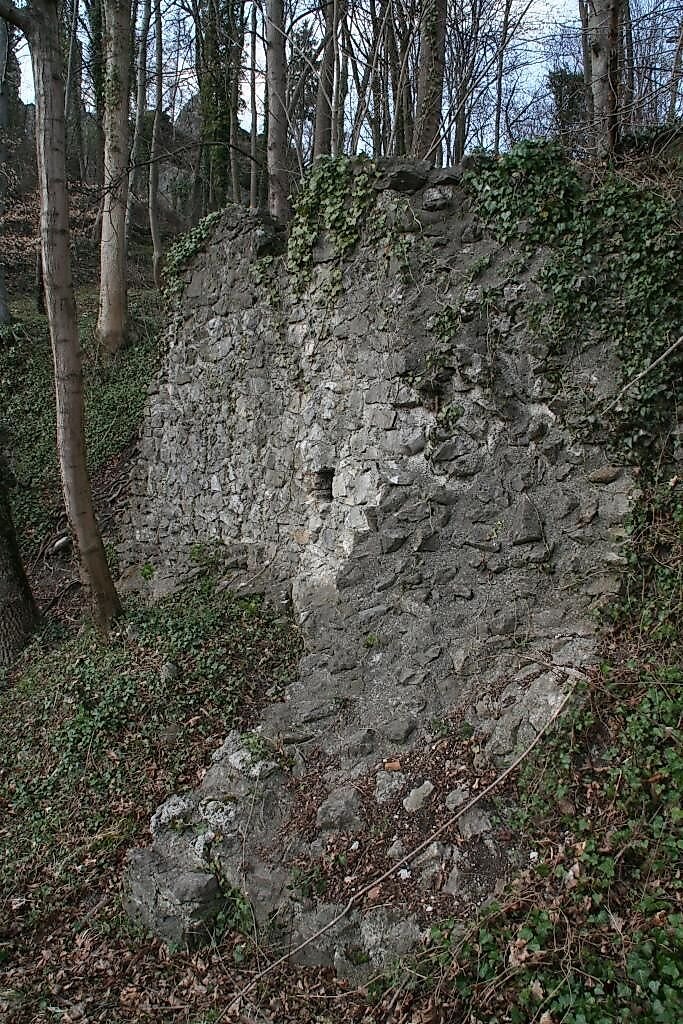
We have now passed beneath the gun and prison towers and have arrived at the entrance to the castle complex, between the first gate—the outer castle gate—and the second gate—the outer courtyard gate. The cistern, which you can see on the left against the rock face, served as an additional water source during times of drought. Neuburg Castle was considered virtually impregnable. It was never destroyed by attackers in its entire history. Its destruction did not begin until after it was sold in 1767. At that time, Neuburg Castle came into the possession of a consortium led by Georg Loacker of Götzis, a local magistrate, through an auction, and was largely demolished. The cellars and walls of many old houses in the vicinity of Neuburg Castle are built from its stones.
Neuburg was conquered during the Appenzell Wars from 1405 to 1408. Count Hugo von Montfort-Bregenz, also known as a minstrel and at that time the lord of Neuburg, was able to save the castle through skillful maneuvering. It was occupied by the “Bund ob dem See” as a stronghold.
In 1647, the Swedes captured Bregenz and, on the very same day, occupied the unguarded Neuburg without a fight. The occupation, involving 90 men, lasted until May 23, 1647, when the Swedes were besieged by Austrian troops and surrendered in exchange for safe passage. Hans Kaspar Jonas lost his position as administrator and was held accountable for the surrender of Neuburg to the Swedes without a fight.
We will now continue on to the bench near the information board.
Location
- Address
- Path beneath the Gun Tower and Prison Tower 6842 Koblach, Austria