


Oak Tree on Glitzweg
Description
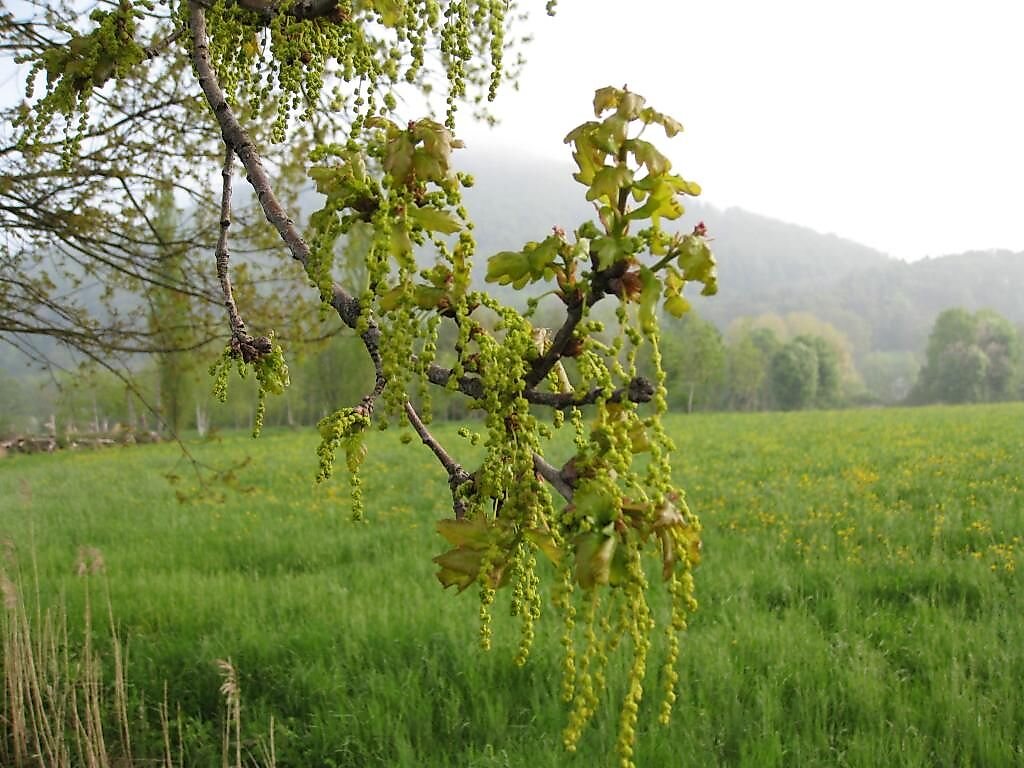
We are standing here by the old English oak; to our east lie the ruins of Neuburg, and to our left and right lies the Koblacher Ried.
The Koblacher Ried stretches south from the Kumma to the Frutz and covers approximately 100 hectares, which is one-tenth of the municipal area of Koblach. Today, the Koblacher Ried serves as a recreational area for us humans, a sanctuary for plants and animals, and a hay meadow for agricultural use.
Approximately 400 owners hold the roughly 600 parcels of land in this cultural landscape, of which 537 parcels are listed in the biotope inventory.
The 1990 Biotope Ordinance for Hay Meadows stipulates that hay meadows should not be drained, fertilized, grazed, or plowed. Mowing should take place once a year between September 1 and March 15.
These measures serve to protect animals—such as ground-nesting birds—and plants. Otherwise, late-blooming flowers, such as the lungwort, cannot develop their seeds.
In the Koblacher Ried, 300 plant species have been recorded, 72 of which are endangered, critically endangered, or threatened with extinction in Vorarlberg and/or Austria.
In every season, the Koblacher Ried offers unique features and allows us to discover natural treasures.
From spring through summer, orchids, various orchids of the genus Epipactis, the bluebell, the marsh orchid, the marsh helleborine, the grass lily, the black helleborine, and the red helleborine bloom,
and the Siberian iris—known in Koblach as “ILGA”—attract many visitors to the Koblacher Ried.
In the fall, the marsh gladiolus, sweet garlic, lungwort, broad-leaved cattail, moor grass, and a variety of reed, sedge, and rush species are in bloom.
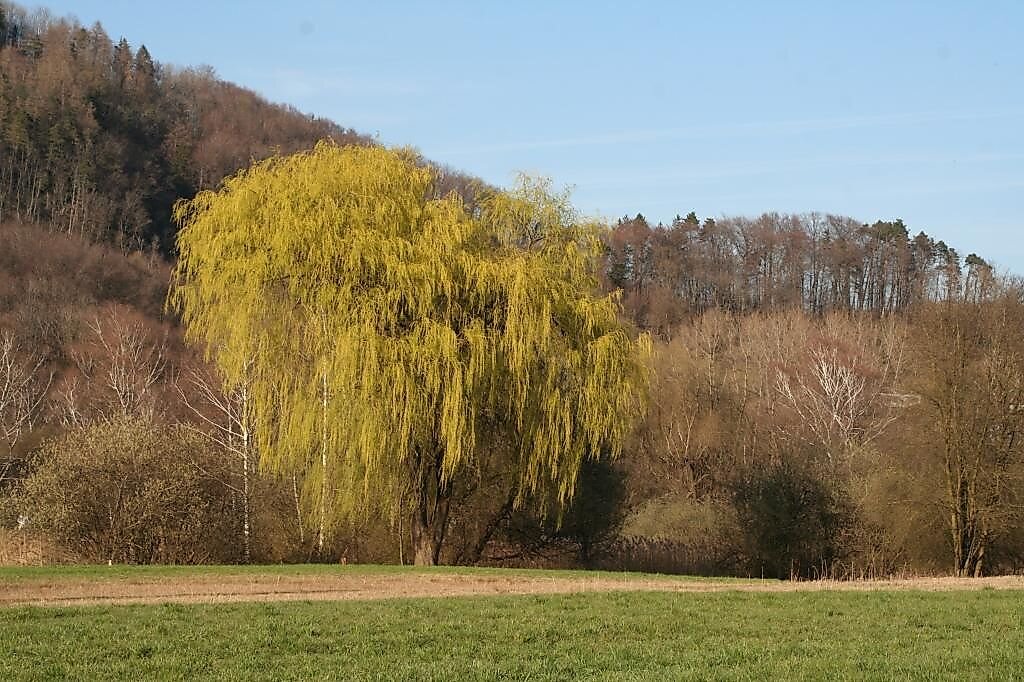
Trees such as the bog birch, ear willow, alder buckthorn, sessile oak, and spindle tree are among the area’s unique features, alongside better-known species like ash, black alder, and oak…
Introduced plants, known as neophytes, such as giant hogweed, late goldenrod, glandular impatiens, Japanese knotweed, slitted-leaf coneflower, and several others also grow here. These plants are beautiful to the eye. However, they tend to grow very quickly and thus take away habitat from the small, slow-growing plants. That’s why regulatory maintenance is necessary.
If we assume that each plant provides habitat for at least 10 animals, then it’s easy to imagine that the Koblach Marsh is also a paradise for wildlife.
120 butterfly species have been recorded, 36 of which are critically endangered or threatened with extinction. For example, the Amethyst Fritillary, the Scabious Checker, the Light and Dark Meadow-knob Ant Blue, the Lungwort Ant Blue…
23 species of dragonflies have been documented, 8 of which are considered endangered in Vorarlberg. For example, the marsh hawker, the spotted hawker, and the banded hawker. Dragonflies need water for larval development, which they find in ditches and puddles.
When the sun is shining, dragonflies and butterflies are happy to show themselves, but spotting their eggs and caterpillars takes a little more time—and a magnifying glass is ideal for this.
Birds: Noteworthy are the meadow-nesting birds, such as the stonechat, the whinchat, the marsh warbler, and the reed bunting.
If you’re lucky, you might spot a pheasant or see a red kite circling in the sky.
Hares and deer are also among the inhabitants of the Koblacher Ried.
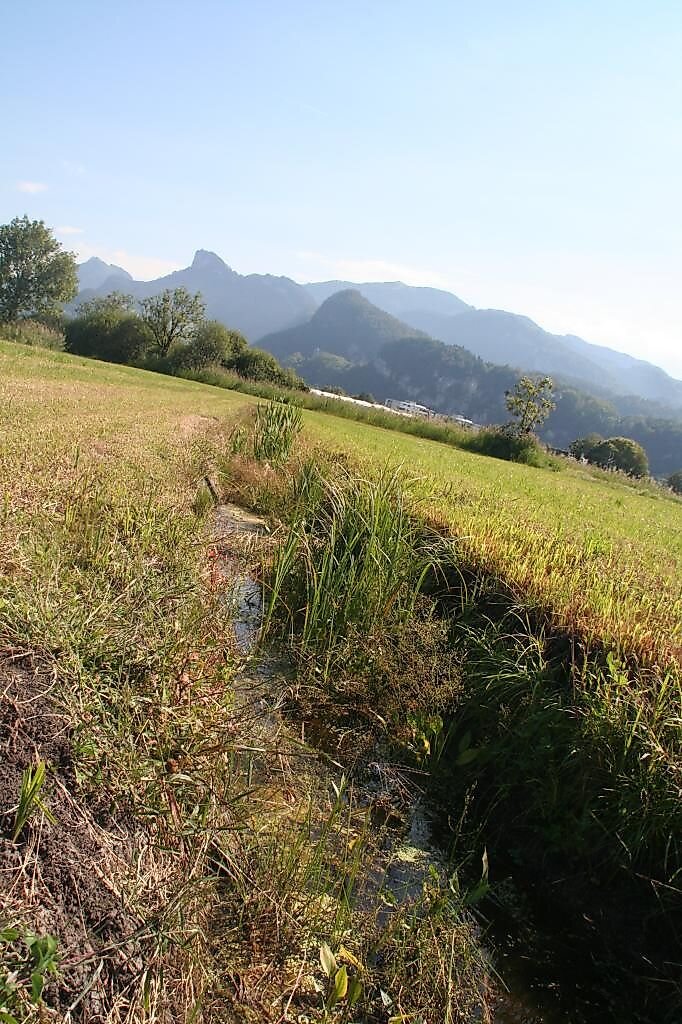
The ditches drain the soil surface and channel the water into streams.
These ditches are tiny biotopes in their own right; they provide habitat for plants that prefer dry conditions and for those that like to have “wet feet.” Flattened banks allow frogs, newts, toads, and other creatures to climb up and down. Yellow-bellied toads, small mussels, water spiders, slit-shelled snails, and more can also be found here.
Maintaining the ditches and the hay meadows is very labor-intensive, especially when the needs of the plants and wildlife are taken into account.
This reed bed formed 14,000 years ago when the Ice Age glacier and, later, Lake Constance retreated from the Rhine Valley. Silting occurred, and in between, the Rhine’s floodwaters repeatedly backed up and deposited material. Peat was formed.
The peat contains preserved cells that have stored information for over 14,000 years—information that can now be scientifically analyzed. It serves as a living archive.
Until 1970, peat was mined in Koblach for about 200 years; it was used primarily as fuel.
Perhaps you’ll discover and recognize some of these treasures on your way to the castle ruins.
The list of plants and animals is intended to spark your curiosity and is by no means exhaustive.
Further information: Koblacher Ried Handbook 2010, Koblach Municipality Biotope Inventory, Butterfly Study by Mag. Dr. Aistleitner, Koblach Municipal Book
Location
- Address
- Oak Tree on Glitzweg 6842 Koblach, Austria