


Follow the Art! Marktplatz, Parish Church of St Martin* – Façade above the Main Entrance – Fresco
Marktplatz, Parish Church of St Martin* – Façade above the Main Entrance – Fresco Josef Huber: “Die vier letzten Dinge” (“The Last Four Things“), 1923
War is Hell on Earth
To commemorate the fallen and missing soldiers of the First World War, the city commissioned a monumental painting to be placed above the portal of the church. Measuring 23 metres in length and 6 metres in height, it was created by the artist Josef Huber.
For this war memorial, Huber chose the theme of “The Four Last Things”: death, heaven, judgement and hell.
On the left, St George leads fallen soldiers to the gates of heaven, followed by orphans and war widows. In heaven, St Martin, the patron saint of the church, kneels before the Holy Family, pleading for the souls of the dead.
At the centre, Christ sits enthroned as the Judge of the World. To the right, Archangel Michael battles the infernal dragon, symbolising the eternal fight between good and evil.
Along the lower edge are theologians and artists who have explored the theme of hell, including Dante, Michelangelo and Rubens.
→ Although in Austria we are fortunate to live in peace in Austria today, war remains a recurring threat.
What might a contemporary anti-war depiction look like?
Josef Huber (1858–1932), painter
The artist is often referred to as Josef Huber-Feldkirch, after his hometown. Initially a student of the Tyrolean church painter Franz Plattner, he later studied in Munich and Paris. From 1909 to 1923, Huber was a professor of ecclesiastical monumental art at the Academy of Art in Düsseldorf. The painter was a historian, influenced by Symbolism, Jugendstil and Expressionism. In his later years, he lived at Neuburg Castle on the River Inn (Germany, Bavaria).
* The parish church of St Martin was first mentioned in 1130. A Gothic church was built in 1453 and its tower is still largely intact today. The neoclassical nave was built in 1839/40.
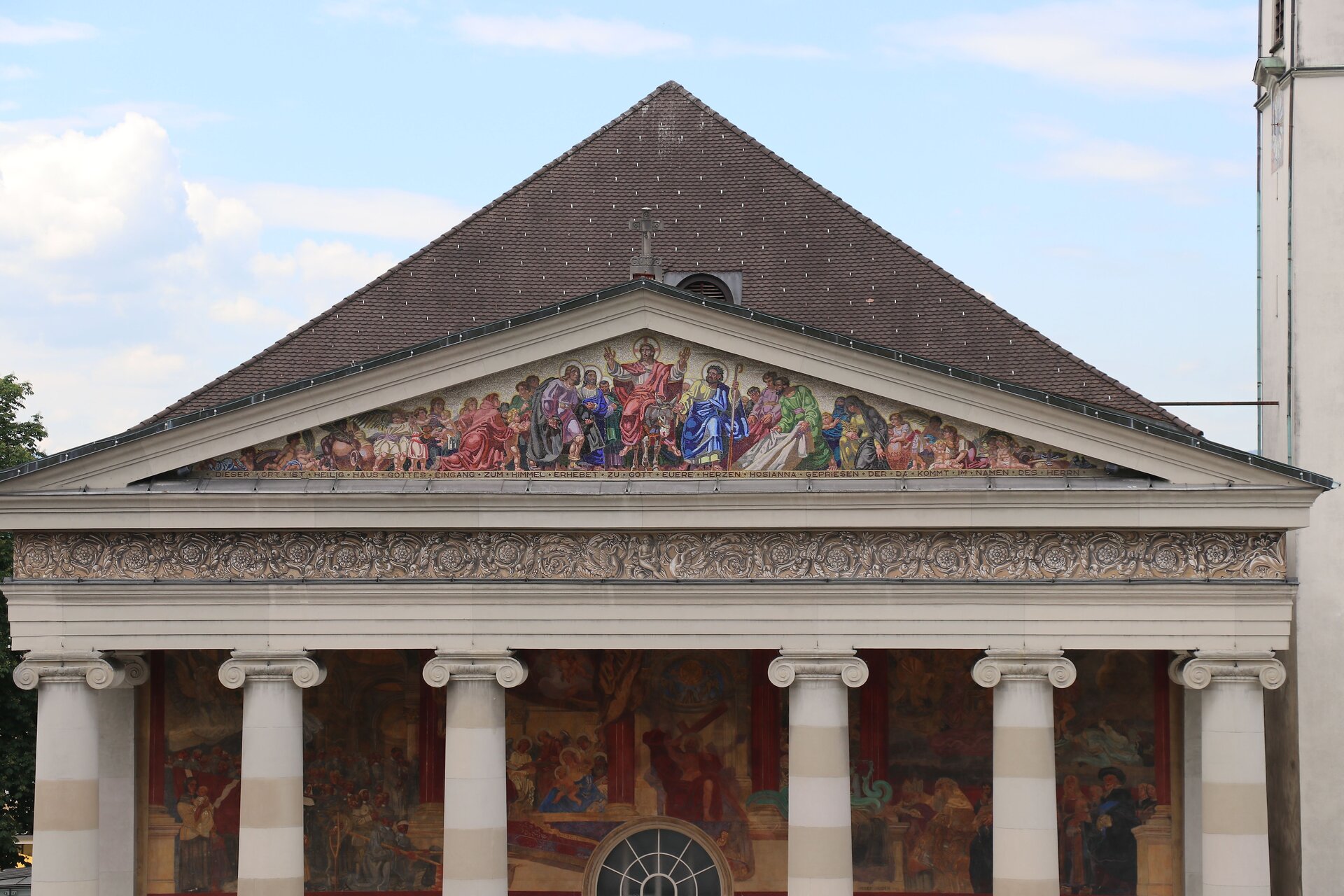
Marktplatz, Parish Church St Martin* – Pediment above the Entrance Façade – Mosaic
Josef Huber: “Einzug Jesu in Jerusalem” (“The Entry of Jesus into Jerusalem”), 1924
Hosanna!
The colourful mosaic in the gable above the church portal is radiantly visible from afar. The depiction of the entry of Jesus into Jerusalem follows the tradition of early Christian and medieval mosaic art: bright colours in the foreground, gold in the background. The work consists of around 1.5 million tiny glass tiles. Jesus is depicted riding on a donkey with his arms raised, surrounded by his disciples. A few spectators can be seen in the corner. In total, the scene includes 34 larger-than-life figures.
The inscription reads: “This place is holy. The house of God. The gate to Heaven. Lift up your hearts to God – Hosanna, blessed is he who comes in the name of the Lord.”
→ What place is sacred to you?
Josef Huber (1858–1932), painter
The artist is often referred to as Josef Huber-Feldkirch, after his hometown. Initially a student of the Tyrolean church painter Franz Plattner, he later studied in Munich and Paris. From 1909 to 1923, Huber was a professor of ecclesiastical monumental art at the Academy of Art in Düsseldorf. The painter was a historian and was influenced by Symbolism, Jugendstil and Expressionism. In his later years, he lived at Neuburg Castle on the River Inn (Bavaria).
* The parish church of St Martin was first mentioned in 1130. A Gothic church was built in 1453 and its tower is still largely intact today. The neoclassical nave was built in 1839/40.
Location
- Address
-
Follow the Art! Marktplatz, Parish Church of St Martin* – Façade above the Main Entrance – Fresco
Marktplatz 1
6850 Dornbirn, Austria
(c) Stadtmuseum Dornbirn / Stadtmuseum Dornbirn