


Bismarck Monument / Imperial Eagle
Brief Description
Detailed Description
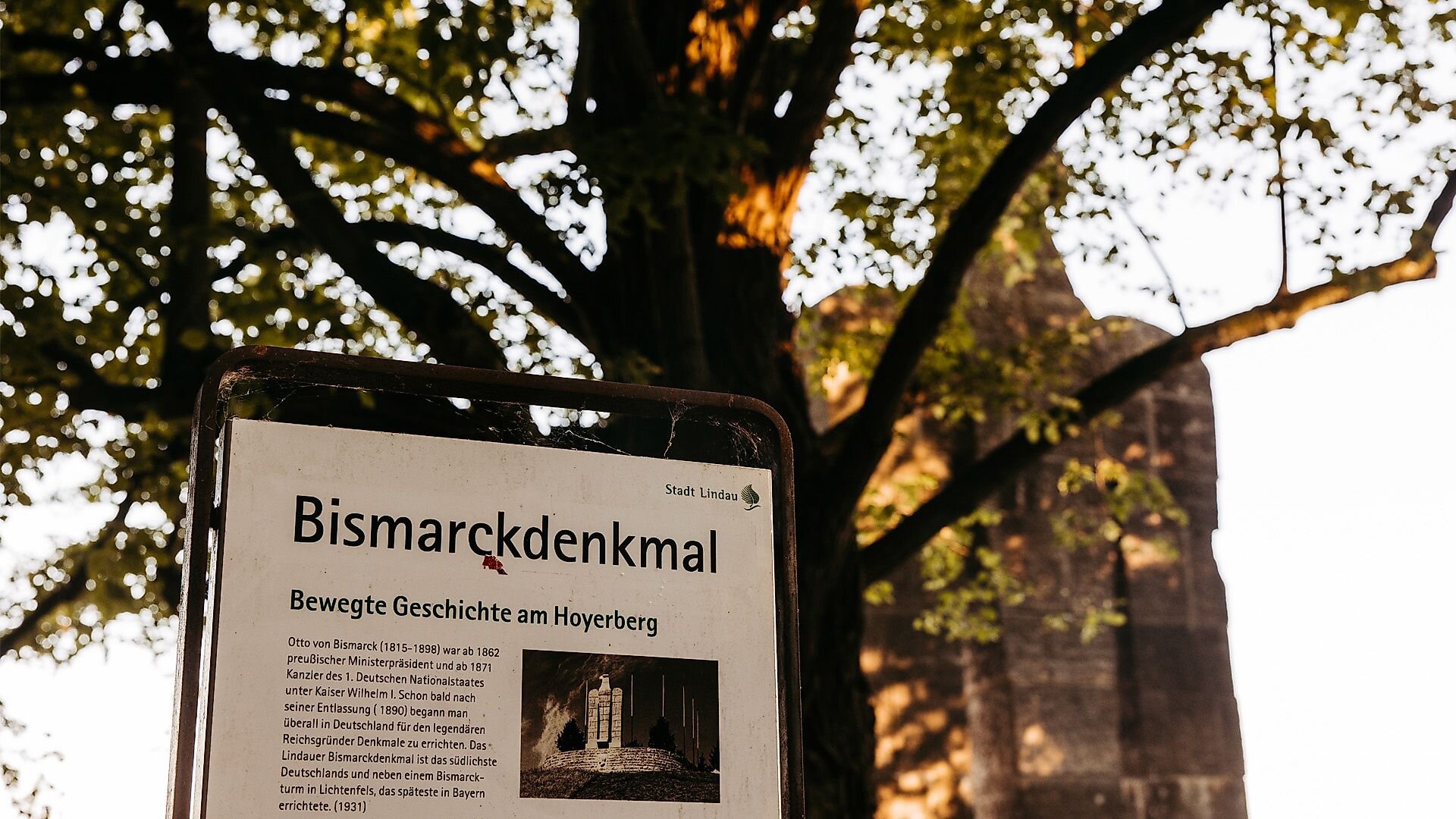
The eight-meter-high structure, built of shell limestone, has a turbulent history—one that, in essence, continues to this day as the story of how it has been received. Efforts to erect a structure that would serve as both a memorial to fallen soldiers and a monument to the “Iron Chancellor” Otto von Bismarck (1815–1898) had been underway in Lindau as early as 1910. But World War I and the end of the German Empire soon pushed these plans into the background.
An entire “Heroes’ Grove” for Lindau?
On top of that, there was disagreement: While an association was founded specifically to erect the monument, there was also an initiative that preferred to create an entire “Heroes’ Grove” at the current site. Nothing came of it; only the name of the access road still recalls the idea of this “patriotic Gesamtkunstwerk” today: Heldenweg. The fact that the monument stands here on the Hoyerberg at all is due to a private donation. A wealthy family from Lindau donated a piece of land on the southeastern slope—which they owned—to the city.
However, the project did not gain momentum again until nationalism began to gain traction in Germany. In 1931, the monument was finally erected by the Munich sculptor Lothar Dietz (1896–1976). For the stone imperial eagle—on which Bismarck is mentioned only on the pedestal by name and likeness—Dietz drew on a stylistic language that was widespread in the artistic sensibilities of the time. The National Socialists adopted this style and turned it into their “state art.”
A legacy of the Nazi era that continues to this day
The fact that the Bismarck Monument did not disappear with the Third Reich is attributed today to the fact that the French military authorities during the occupation saw nothing objectionable in it: after all, it contains no Nazi symbols. However, the Bismarck Monument is now dilapidated, and restoration would likely be costly. Should this now be taken as an opportunity to alter the imperial eagle’s appearance as well and rid it of the stigma of “Nazi art”?
To find the right answer to this question, people in Lindau are eager to engage in discussions, where a wide range of viewpoints are sometimes expressed. The fact that this is possible today is perhaps the most important insight that can be drawn from monuments of that era: that we now live in a free, democratic society where an open and unrestricted exchange of ideas is possible.
Location
- Address
-
Bismarck Monument / Imperial Eagle
Heldenweg
88131 Lindau